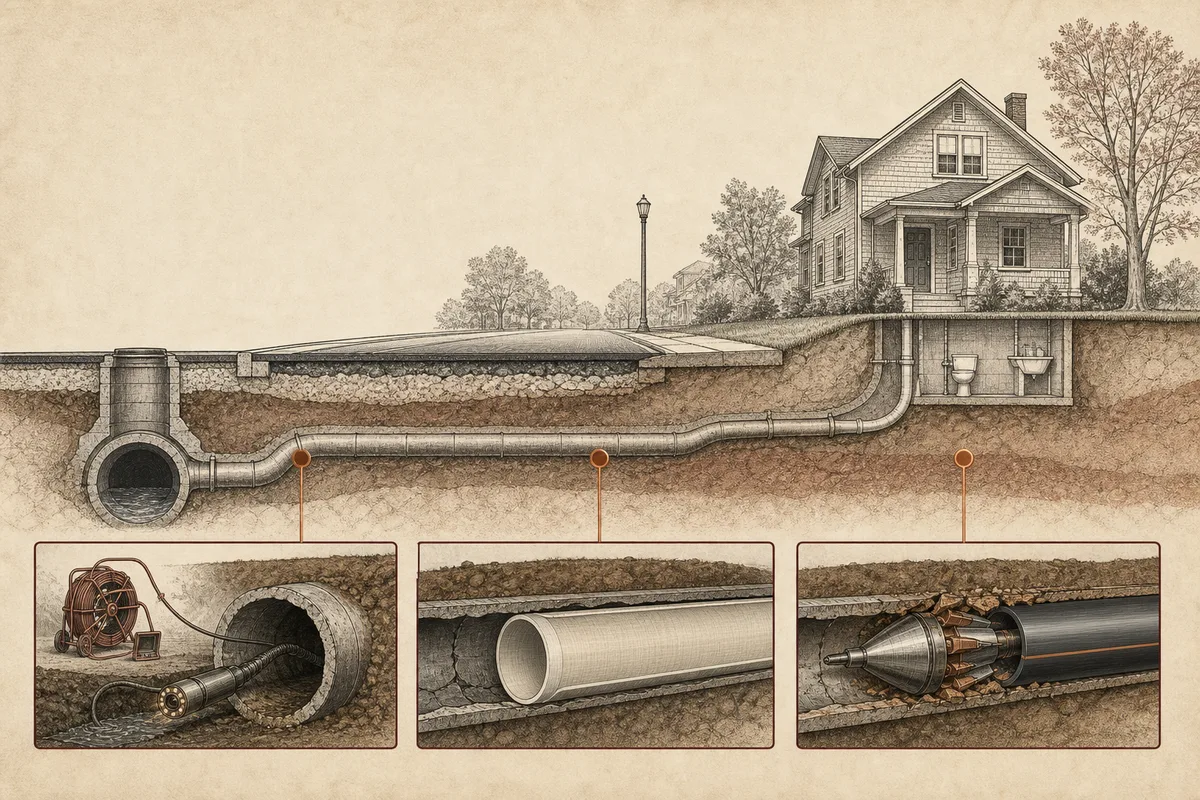
Amherst Elite Trenchless maintains a local field note for East Amherst, about 5 miles from Amherst in this planning ring. 1980s through 2000s subdivisions sit across clay-rich ground where seasonal movement can stress joints even when the pipe material is newer PVC.
East Amherst pipe context starts with the address
The first decision is not lining versus bursting. It is whether the property uses a public lateral, a limited district connection, a private onsite system, or another arrangement. The East Amherst municipal website is a jurisdictional starting point, and the Erie County sewer forms library provides county-level sewer contacts and applications.
1980s through 2000s subdivisions sit across clay-rich ground where seasonal movement can stress joints even when the pipe material is newer PVC changes the inspection questions for this page. A route through older blocks, clay-rich ground, mature trees, compact lots, island conditions, or mixed utility territory cannot be scoped from a regional average. The serving system and private route must be verified for the actual parcel.
Local planning markers that are specific to East Amherst
Newer subdivision pipe can still experience joint stress where clay-rich ground moves seasonally.
PVC material should not be treated as proof of good bedding, grade, or fitting condition.
Longer setbacks can increase footage, locating work, and the importance of a reliable distance counter.
An East Amherst scope should identify easements and utility corridors before a bursting path is proposed.
Subdivision records may help confirm installation era, but the current camera condition remains decisive.
The page-specific field premise is this: 1980s through 2000s subdivisions sit across clay-rich ground where seasonal movement can stress joints even when the pipe material is newer pvc. That premise should be checked against current parcel records and camera evidence because 1980s through 2000s subdivisions sit across clay-rich ground where seasonal movement can stress joints even when the pipe material is newer pvc.
What the East Amherst camera survey should record
For this local context, 1980s through 2000s subdivisions sit across clay-rich ground where seasonal movement can stress joints even when the pipe material is newer pvc. The survey should therefore identify the access point, material, diameter, joints, transitions, visible defects, distance counter, surface locations, and the point where the camera stops.
If roots, grease, scale, or standing water hide the wall, record that first limitation. A later clean-pipe pass should be kept separately so the before-cleaning symptom is not confused with the structural condition beneath it.
The written defect map should use stations or distances. A statement such as roots were found is less useful than a record tying root entry to one joint, material transition, or repeated interval.
Method comparison for East Amherst properties
Where 1980s through 2000s subdivisions sit across clay-rich ground where seasonal movement can stress joints even when the pipe material is newer pvc, a method comparison must account for both the defect and the surface access. CIPP lining can rehabilitate a cleanable host with usable geometry. Pipe bursting can replace some collapsed or deforming routes when pits and utility clearance are workable. A spot repair can be appropriate for one bounded defect surrounded by sound pipe.
None of those labels is a remote diagnosis. Long standing water can indicate a grade problem that lining will follow. Severe deformation can remove a liner path. Tight bends or crowded utilities can remove a bursting path. A failed fitting may be easier to repair through controlled access.
Local access questions for a East Amherst scope
The fact that 1980s through 2000s subdivisions sit across clay-rich ground where seasonal movement can stress joints even when the pipe material is newer pvc makes route locating and surface planning important before equipment arrives. Identify drives, walks, additions, finished rooms, mature trees, retaining walls, public rights of way, nearby utilities, and likely pit or cleanout positions.
Ask who obtains the permit, who schedules inspection, how excavated material is handled, and which surfaces are restored. A trenchless proposal can still include pits, interior access, traffic control, or a small conventional repair.
Cost variables around East Amherst
For East Amherst, the local profile is not a price multiplier by itself. Cost comes from measured length, depth, access, preparation, diameter, method, groundwater, utility conflicts, permits, inspection, and restoration. 1980s through 2000s subdivisions sit across clay-rich ground where seasonal movement can stress joints even when the pipe material is newer PVC is useful because it identifies which of those variables deserve early attention.
Compare complete scopes against the same footage. One quote may include cleaning, locating, reinstating branches, post-work video, and surface restoration while another leaves those items provisional.
Records to keep after work in East Amherst
Retain the property address, system confirmation, complete pre-work video, defect map, written scope, permit or inspection records, material information, restoration terms, and closing footage. If the camera could not reach the public connection or onsite destination, keep that limitation with the record.
Those files matter in East Amherst because 1980s through 2000s subdivisions sit across clay-rich ground where seasonal movement can stress joints even when the pipe material is newer pvc. They help a future owner or manager distinguish a documented repair from a general claim that the sewer was done.
Stop points that deserve a written note in East Amherst
Because 1980s through 2000s subdivisions sit across clay-rich ground where seasonal movement can stress joints even when the pipe material is newer pvc, the record should explain any station where the camera could not advance, the pipe wall could not be seen, or the route could not be located. A clean bill of health should never be inferred beyond that stop point.
The same local premise means a repair endpoint in East Amherst should be tied to a surface location and a named material transition. If the survey ends before the public connection or onsite destination, preserve that distance and limitation with the property file.
Send a East Amherst property field note
Use the request form to share the street, property type, public sewer or septic status if known, symptoms, and any existing footage. Or review the full Amherst-area coverage ledger before comparing methods.
Decision check
Confirm the property system before scoping the line
01Is the property on public sewer, a limited district, or septic?
02Which part of the private piping is involved?
03What access, groundwater, surface, or ledge constraints apply?
04Which municipal records or permits should be checked?
Questions
Frequently asked
01Is every East Amherst property on the same sewer system?
No address should be classified from the town name alone. Confirm the serving utility, sewer district, or onsite system from current property and agency records.
02What should a East Amherst camera report include?
Keep the access point, distance reached, pipe materials, transitions, defect stations, stopping point, and the full video file.
03Does trenchless mean there will be no digging?
Not always. Lining may use existing access, while bursting normally needs pits. Collapses, fittings, and route changes can require selective excavation.