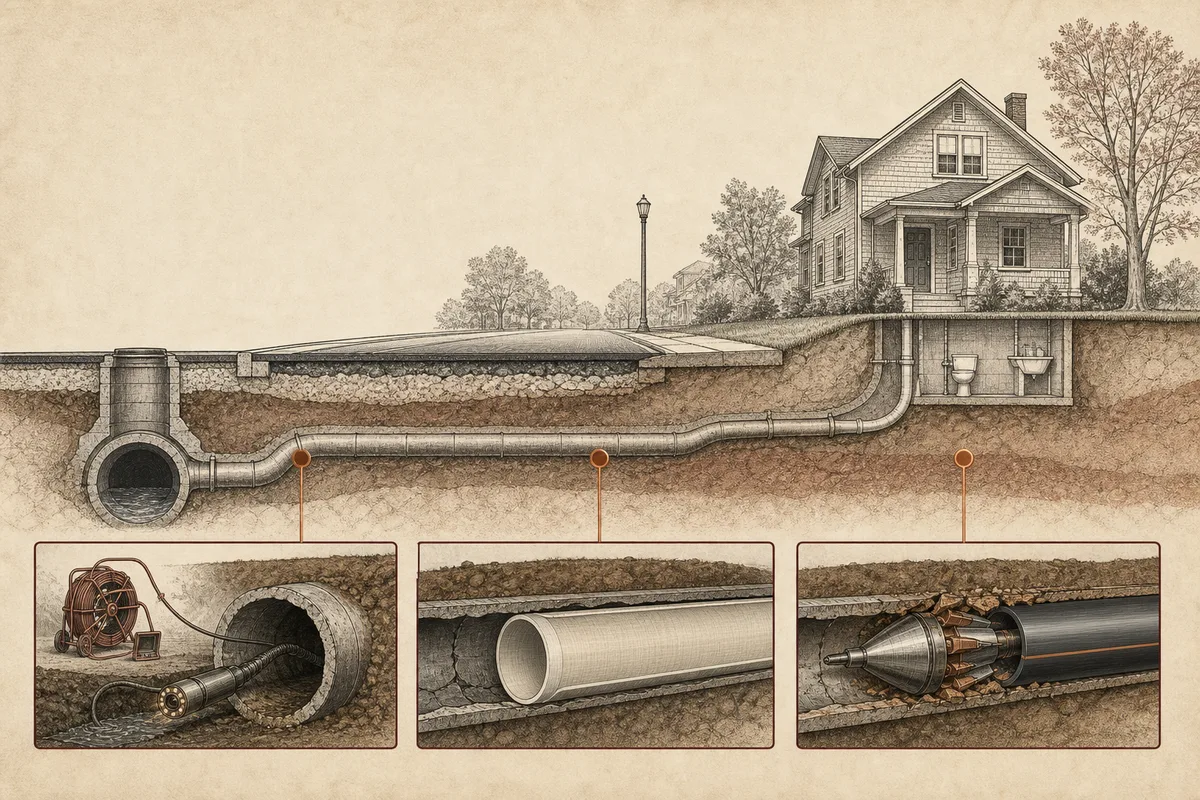
Amherst Elite Trenchless publishes camera-led method guides for Amherst property owners and managers. A backup describes a symptom, not a repair method. The source can be a private branch, the building sewer, a shared connection, or the public collection system.
Sewer Backup Repair: define the pipe problem first
Symptoms such as a backup, slow fixture, odor, wet ground, or failed purchase inspection do not identify the repair method. Record the access point, pipe material, diameter, direction, defect distance, and the portion that could not be viewed. First limit water use and establish which fixtures and properties are affected. Then locate the obstruction or defect before promising a structural repair.
For Amherst properties, the private lateral must also be separated from the public collection system. The Town of Amherst sanitary sewer I&I program is an authoritative starting point for municipal context, while the Erie County Division of Sewerage Management forms publishes county sewer forms and contacts. Current requirements still need address-level confirmation.
Evidence required for an Amherst sewer backup repair scope
A useful field record includes the complete footage or locating record, the inspection date, measured stations, observed material changes, cleanout or pit locations, surface marks, and a written explanation of the defect. If deposits hide the wall, the scope should distinguish the first obstructed pass from a later clean-pipe pass.
The recommendation should answer four questions: What failed? How much of the line is affected? Why does this method fit the recorded geometry? What evidence will show that the work was completed as scoped? A proposal that cannot answer those questions is difficult to compare with another bid.
Build a station log that another reviewer can follow
Start at a named access point and record the direction of travel. For each observation, keep the distance, pipe material, approximate clock position, severity, and whether the view was obscured. Surface-locate the important stations and photograph the marks in relation to fixed features such as the foundation, walk, drive, curb, or cleanout. This turns a video into a record that can support sewer backup repair planning.
Do not discard the unedited recording after screenshots are exported. Short clips are useful for discussion, but the continuous file shows the approach to the defect, the sound pipe around it, and any condition farther downstream that could change the scope.
Where sewer backup repair fits the method comparison
First limit water use and establish which fixtures and properties are affected. Then locate the obstruction or defect before promising a structural repair. That decision should be compared with camera inspection, CIPP lining, pipe bursting, a targeted repair, and excavation where those paths are relevant.
The comparison should cover preparation, access, downtime, branch connections, bypass or flow control, permits, inspection, restoration, and closing records. The least disruptive method is not automatically the least expensive when its prerequisites are missing.
Conditions that can rule out sewer backup repair
An active sewage release is a health and property issue. This informational website is not an emergency dispatch service. Other constraints can include an unknown shared connection, a sharp change of direction, inaccessible fittings, unstable soil, groundwater, adjacent utilities, protected surfaces, or a route that cannot be located confidently.
Method limits should appear in writing. A condition that changes the proposed approach should also trigger a revised scope rather than an informal field substitution.
Amherst access, permits, and property responsibility
The Town of Amherst actively addresses infiltration and inflow in the sanitary system. Its program describes public inspection and rehabilitation work, including camera televising and cured-in-place lining, while private-property responsibility remains a separate question. That local context makes defect location and ownership important before a private repair begins.
Confirm the current permit holder, inspection notice, utility marking, restoration obligation, and point where private responsibility meets the public connection. Properties outside the town or within a different sewer district may follow another agency process.
Cost drivers for sewer backup repair in Western New York
Price changes with length, depth, diameter, access, preparation, material, equipment placement, traffic control, groundwater, surface restoration, and the certainty of the inspection. Winter conditions and saturated clay can affect field planning, but the property record should govern the actual allowance.
Use the Amherst sewer repair cost guide as a comparison checklist, not a remote quote. Ask each bidder to identify assumptions, allowances, unit prices, and exclusions against the same defect map.
Compare proposals line by line
Put inspection, cleaning, locating, access, flow control, repair material, branch treatment, permits, testing, closing footage, spoil handling, and surface restoration into one comparison table. A proposal for sewer backup repair may look lower because a required preparation or restoration item is excluded. Record who carries each allowance and what event converts it into an added charge.
Also compare the failure plan. The written scope should explain what happens if cleaning exposes worse geometry, the camera cannot pass, a utility conflict changes the access, or the selected method cannot reach the planned endpoint. A clear decision point protects the owner from an open-ended field change.
Closing proof after sewer backup repair
Keep the pre-work record, approved scope, permits, product or replacement material data, inspection signoffs, restoration terms, and a post-work camera or test record. The closing evidence should identify the same segment and stations described before work.
For a purchase, managed building, or future tenant handoff, store those files with the property records. They make later maintenance and warranty questions much easier to answer.
Request a method comparison for Sewer Backup Repair
Send the Amherst-area property address, system type if known, symptoms, existing footage, written defect locations, and access concerns through the review form. This site provides planning information and routes requests; a qualified local provider must inspect the property before issuing a final scope.
Decision check
Questions a useful recommendation should answer
01What material, diameter, and defects appear on the camera footage?
02What preparation is required before the proposed method can work?
03Which alternatives were ruled out, and why?
04What closing evidence and written scope will the property owner keep?
Questions
Frequently asked
01What should be documented before sewer backup repair is recommended?
Keep the full camera or locating record, material and diameter notes, defect stations, access limits, and the reason competing methods were ruled in or out.
02Can sewer backup repair avoid every excavation?
No. Access, collapsed pipe, fittings, route changes, utility conflicts, or required restoration can still create a controlled excavation area.
03What should be kept after the work?
Retain the written scope, permits or inspection records, product and material details, and a closing camera or commissioning record for the repaired segment.