Amherst Elite Trenchless maintains this Boston field note for a town in southern Erie County, roughly 24 miles out in the service planning ring. The distance and the approximate population marker describe coverage planning rather than a measured trip or any finding about a specific parcel. Boston sits on the rising ground south of Orchard Park and north of Holland, where suburban plats give way to larger hill lots, which reorders the first questions a crew should ask.
Hill lots on the slope between suburb and farm
Boston occupies a middle ground that neither neighbor quite matches. It is not the denser village-and-subdivision pattern of Orchard Park, nor the deep working-field country of Holland farther southeast. The town climbs across rolling hills and valleys drained by the branches of Eighteen Mile Creek, with homes spread over larger parcels along ridges, in hollows, and off long rural roads through hamlets like Boston, Patchin, and North Boston. That geography puts two features in front of a crew at once: a lot large enough to hide the real pipe path, and a grade that the building sewer has to follow.
Out here the house is often set back from the road and placed on a bench cut into sloping ground. A drain can run steeply downhill toward the pavement, sidelong across a hillside toward a tank, or down into a low spot where water already collects. The length and the fall of that private run are rarely obvious from the driveway. A gravel lane points toward the road, but the pipe may bend toward a disposal field on the downhill side instead. Begin with records and a located inspection rather than drawing a straight line from the back door to the right of way.
Confirm sewer or septic at the address
The opening question for a Boston property is not which trenchless method to pick. It is what the parcel is connected to at all. Some addresses may tie into a public or district sewer where one reaches; many on the more rural hill sections rely on a private onsite tank and disposal field; others sit in arrangements that only the records will reveal. This page does not claim any particular public sewer coverage for Boston, because that is exactly the detail to confirm by address rather than assert from a town name. A neighbor’s connection up or down the same hill does not decide what serves the parcel next door.
The Erie County sewer forms library, referenced by neighboring field notes as well, is one starting resource where county sewer records apply. Confirm the real permit and inspection path for the address and the type of work before anything gets scheduled, and ask who obtains approvals when a run crosses toward a road or right of way. For a septic property, establish the applicable onsite approval path first. Fixing a building-to-tank pipe does not demonstrate that the tank, the distribution box, or the disposal field is functioning, and those are separate scopes that need their own evaluation.
Grade is the question the hills force
On a Boston hill lot, slope is not a detail to note after the fact; it shapes the whole plan. A building sewer is meant to fall at a steady, moderate grade so solids and water move together. Steep ground tempts a run that drops too fast in one stretch and then flattens, and a settled joint or a soft spot can leave a sag or a short length of back-pitch that collects debris no matter how the hillside looks from above. None of that can be read from the surface. A located sewer camera inspection that records the fall, the low points, and where water stands is what turns a guess about grade into evidence. Compare what the slope suggests with what the camera actually shows, and resist assuming a downhill lot keeps a line clear on its own.
Clay-heavy soil and seasonal wet ground
The ground under this part of the county tends toward heavy clay that holds water, and on a hillside that water does not simply sit; it moves downhill and pools in hollows, low yard corners, and creek-fed draws that stay saturated through wet seasons. For buried pipe planning, that matters in two ways. A trench opened in soft, water-holding clay on a slope behaves differently than one in dry, level ground of the same depth, affecting how long an excavation stays open and how backfill and surface repair settle afterward on a grade. And a high seasonal water table in a low spot can turn a routine dig into a pumping job, which belongs in the plan before equipment arrives rather than as a surprise on the day.
None of that soil behavior proves a pipe has failed. Root intrusion, joint separation, and standing water inside the line each need direct evidence from the pipe itself. On a long downhill run, pinpointing where the defect sits is what keeps the scope honest, because a problem near the house high on the slope and one down near the road call for very different access. Compare what the surface drainage shows with the located pipe route, and do not read every wet patch at the bottom of a yard as a leak underground.
Build a complete camera record
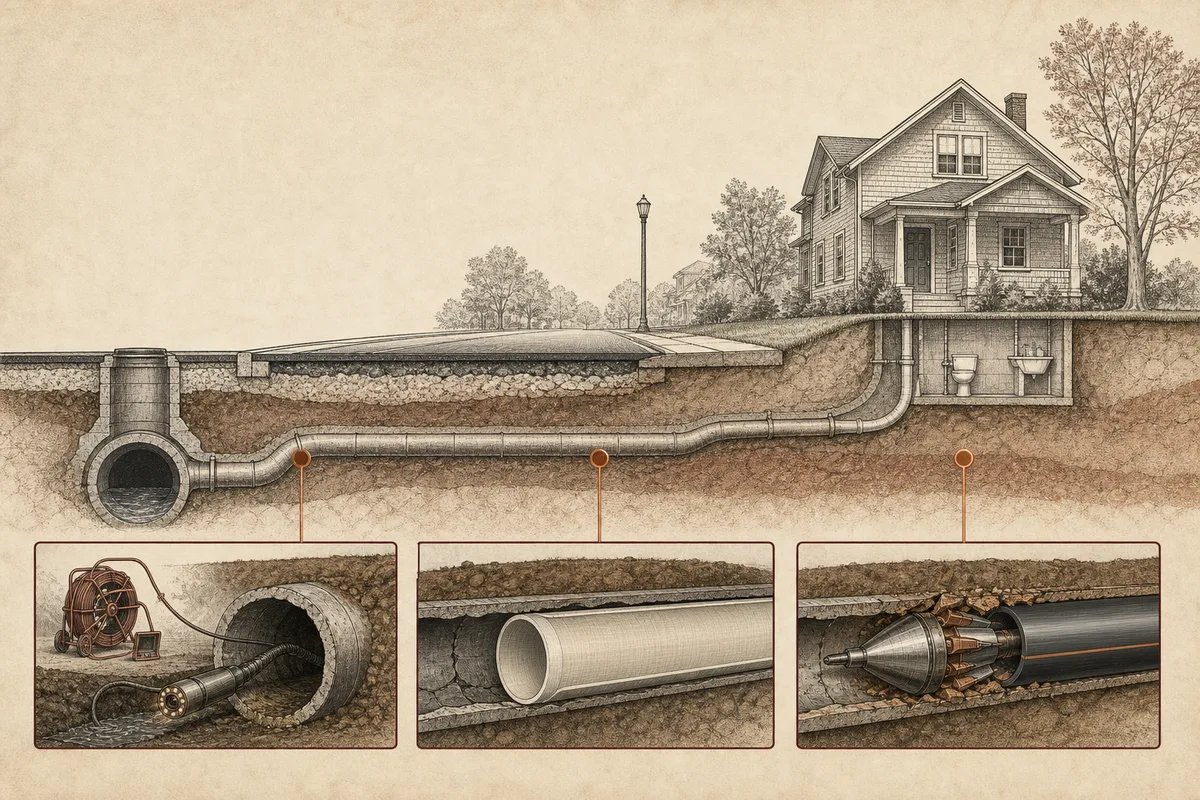
A camera survey on a Boston lateral should record the access point, the direction and the fall of travel, the distance reached, the pipe materials and diameter, any transitions, visible defects, and the point where the camera stops. Locate the relevant stations at the surface so a proposal can say where work will actually happen across a sloped lot. Keep the full footage, including any stretch that could not be assessed. A long downhill run that ends at a blockage is a partial survey even when the reachable section looks sound, and labeling it complete would overstate what is known.
When roots or buildup hide the pipe wall, log the starting condition and the cleaning plan as their own step. Hydro jetting or another suitable method may clear a line enough for a second, clean pass where the pipe’s condition allows it. Cleaning and structural repair stay separate decisions. On Boston’s longer house-to-destination runs across a grade, confirm that access and equipment can actually reach the intended endpoint before anyone promises a full lining or replacement scope.
Compare lining, bursting, and selective excavation
Trenchless pipe lining can be considered when a Boston host pipe cleans up and keeps a usable, round shape along the run. A liner can address qualifying joint and wall defects while sparing much of the surface above a long lateral. It follows the existing pipe, though, so it cannot lift a sag or build a new slope on a hill that already drops too fast or flattens in the wrong place. Document any standing water and the limits of what was measured before presenting lining as the fix for a recurring backup.
Pipe bursting replaces a line along its existing path where the layout, nearby utilities, ground conditions, and access support it. A larger hill lot may offer workable launch and receiving positions, but those pit locations still need a site assessment, and buried field drains, outbuilding services, or a steep grade can constrain where they land. Sewer line repair or replacement may call for selective or broader excavation when the route, grade, or damage rules out a suitable trenchless scope. Compare each method against the same located defects; a long sloped lateral does not automatically favor one approach, and sparing a driveway only helps if the finished pipe also resolves the documented failure.
Plan access, ownership, and restoration
On a rural Boston parcel, map the equipment route with the same care as the pipe route. Identify drive surfaces, benched yards, landscaping, trees, drainage swales, outbuildings, private utility runs, wells, and any known onsite components before work is scoped. Confirm where spoil can go and where deliveries stage on sloping ground. A wide hill setback provides room while still requiring protection of a lawn, a hillside, or a gravel lane, and it can make hauling and staging harder, not easier, when the grade is steep.
Settle the ownership line, too. The boundary between the private building sewer and any public or shared portion comes from the records for that address, and it decides who is responsible for which section. The written scope should show each proposed pit or cleanout, describe backfill, surface repair, and drainage restoration on a grade, and set out the inspection sequence. Use the sewer repair cost guide to compare length, depth, cleaning, access, method, utilities, approvals, and restoration rather than treating acreage or elevation as a price. Then keep the system confirmation, original footage, located defect notes, approved scope, permit and inspection records, and closing video together, so a later owner can see what was renewed and what still lies beyond the completed work.
Nearby southtowns field notes
Compare the Orchard Park field note for its walkable village core and denser later subdivisions, Hamburg for its denser Lake Erie shoreline and Eighteen Mile Creek context, and Holland for its deep farm parcels farther southeast. Boston’s note centers instead on hill lots, grade-driven runs, clay ground with seasonal wet yards, and sewer-or-septic confirmation by address. Nearby geography frames the questions; the parcel records and camera evidence decide the repair.
Use the request form to share the Boston property location, known system type, symptoms, access concerns, and any existing footage. The coverage ledger lists the surrounding service ring for comparison.
Repair paths
When a Boston sewer line needs more than cleaning
A mapped defect can point past routine cleaning toward a specific repair. A sudden failure that cannot wait is handled as emergency sewer repair in Boston, while wastewater returning through a floor drain points toward sewer backup repair for Boston homes. Mature trees reaching an aging clay joint are the usual reason for tree root removal on a Boston lateral, and a line running beneath a basement floor can call for sewer repair under a slab in Boston.
Where the camera record rules out keeping the host pipe, a Boston property may compare trenchless sewer replacement in Boston or, for a failing supply line, trenchless water line replacement in Boston. Older mid-century fiber conduit shows up as Orangeburg pipe replacement across Western New York, and a flooded yard or parking drain can need storm drain pipe repair in Boston.
Nearby areas
Sewer and pipe repair near Boston
Private sewer and water line context carries across town lines, so the field notes for neighboring communities use the same address-first checks.
Decision check
Confirm the property system before scoping the line
01Is the property on public sewer, a limited district, or septic?
02Which part of the private piping is involved?
03What access, groundwater, surface, or ledge constraints apply?
04Which municipal records or permits should be checked?
Questions
Frequently asked
01Does the hill grade on a Boston lot change how a lateral should be assessed?
Sloped ground means a building sewer may run steeply downhill to the street or to a tank, and a sag or back-pitch on that grade behaves differently than one on flat land. Read the actual fall from camera and locate data for the Boston address rather than assuming the slope alone keeps the line draining.
02Is a Boston property more likely to be on septic than public sewer?
Parcels on the more rural hill sections may rely on an onsite tank and field, while others could tie into a district where one reaches, but that is only a planning assumption. Confirm what serves a given Boston address from current property and agency records before any method is compared.
03Why do seasonal wet yards around Boston matter for a dig?
Clay-heavy ground that holds water, combined with downhill runoff and a high seasonal table in low spots, can soften an excavation and slow backfill and restoration. Record how wet the planned route has been so a crew can time any dig against ground conditions, not just the calendar.
04Where does my responsibility for the Boston pipe begin and end?
The ownership line between a private building sewer and any public or shared portion comes from the records for that parcel, not from a neighbor's layout on the next hillside. Confirm the boundary for your Boston address before a scope assigns who repairs which section.
05Can one camera pass cover a long downhill Boston lateral?
A long run that drops across a hill lot, with bends or an obstruction, may stop a camera short of the destination. Document how far the survey reached and plan additional access before treating a partial pass as a complete picture of the pipe.