Amherst Elite Trenchless maintains a local field note for East Aurora, about 24 miles from Amherst in this planning ring. Storefronts and homes along the arts-and-crafts-era Main Street sit inside a much larger town of newer subdivisions, so lateral age can change within a few blocks.
A Main Street village and a spread-out town are not one housing pattern
East Aurora carries two distinct planning contexts under a single name. The compact village core grew up around Main Street during the Roycroft arts-and-crafts era, and that stretch still carries a dense mix of storefronts, converted carriage houses, and close-set early-twentieth-century homes with laterals that predate modern plastic piping by decades. The much larger surrounding town added most of its housing well after that period, on bigger lots with more setback, longer driveways, and easier side-yard access for equipment. A crew scoping a lateral two blocks off Main Street should expect a different material, depth, and curb-to-house distance than a crew working a subdivision several miles out, even though both addresses share the same town name on file. Treating East Aurora as one uniform housing era would miss that split entirely.
Confirm the serving system before comparing methods
The first planning question for an East Aurora address is not lining versus bursting. It is whether the parcel connects to a public sewer lateral, falls inside a limited sewer district, relies on a private onsite system, or sits in some other arrangement entirely. Outlying sections of the town, farther from the village center, are more likely to include a septic system than parcels inside or near the Main Street core, but that is only a planning assumption, not a confirmed fact for any specific property. The Erie County sewer forms library provides county-level sewer contacts and applications that can apply depending on where a given parcel’s district lines fall. No contractor should classify a lateral from the town name alone; only current property and agency records settle what actually serves an address.
Why Western New York clay changes the inspection questions here
Heavy clay-based soil runs through most of this part of Western New York, and East Aurora sits squarely in that pattern. Clay holds moisture longer than sandier ground, so a saturated trench near the village core can stay soft well after a storm has passed, which complicates excavation timing compared with a dry-ground job of the same length. That same clay movement tends to stress pipe joints over the decades, which is one reason a Main Street-area lateral can show joint separation on camera even when the pipe material itself still looks structurally sound otherwise. None of that soil behavior substitutes for a defect map. It tells a crew which questions to ask before equipment shows up: how wet has the ground been near the planned dig, where does runoff pool close to the route, and whether a low spot along that route collects water after every rain.
Local planning markers worth noting for an East Aurora property
A lateral near the historic Main Street corridor may still carry clay, cast iron, or an early transitional material installed long before PVC became the standard choice. A home in one of the town’s newer subdivisions is more likely to run plastic pipe throughout, though bedding and grade issues can still show up regardless of how recent the material is. Mature trees along the older village streets put root pressure close to several laterals at once, which only a camera pass can confirm joint by joint. A property near the edge of the village boundary can end up closer in lateral age to its village-side neighbor than to a same-town address out among the newer subdivisions. Grade and low-spot drainage deserve a direct look before any method gets compared, since clay ground tends to amplify whatever grade problem already exists underneath a driveway or lawn.
What an East Aurora camera survey should record
The recording standard does not change because of where inside the town a property sits. A survey should identify the access point, pipe material, diameter, joints, transitions, visible defects, a distance counter, surface locations, and the exact point where the camera stops. If roots, grease, scale, or standing water obscure the pipe wall, that limitation belongs in the record as its own finding, with a later clean-pipe pass kept separate so a before-cleaning symptom does not get mistaken for a structural defect underneath it. A written defect map tied to stations or distances is far more useful than a general note that roots or standing water showed up somewhere along the run.
Method comparison for East Aurora properties
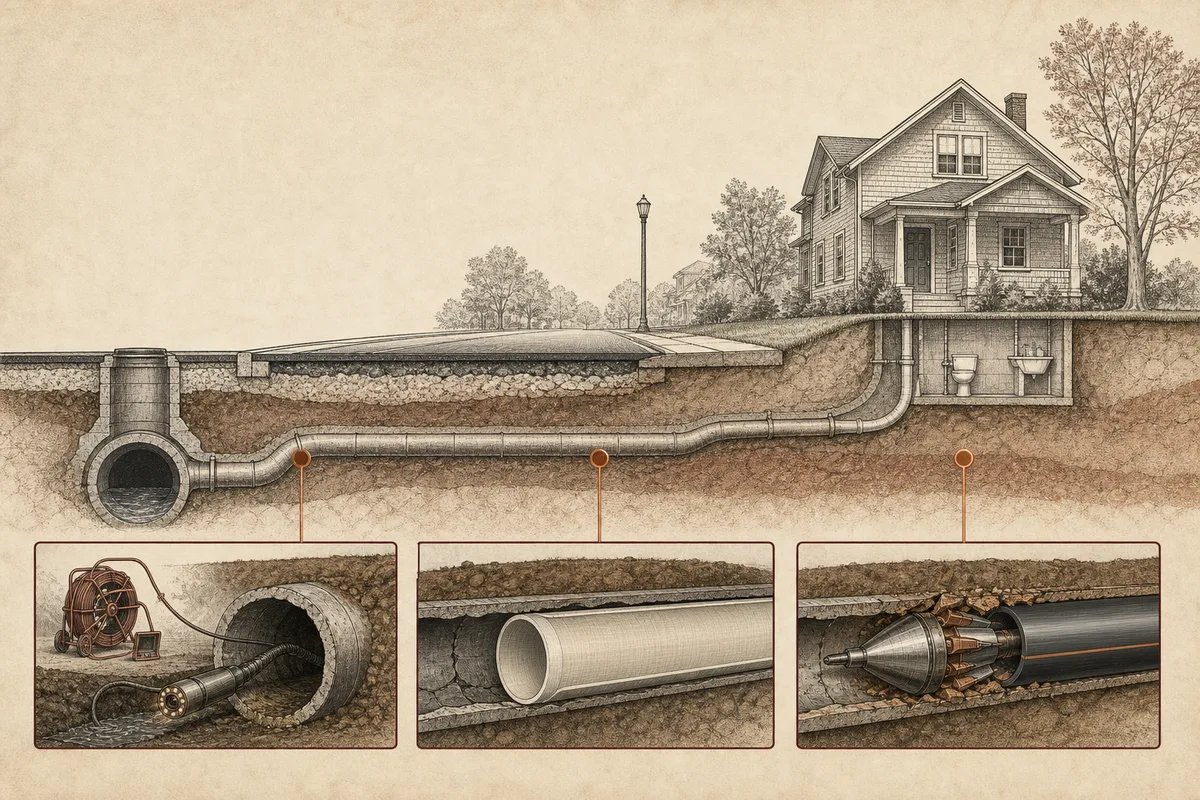
Once a village-core or subdivision lateral has a documented defect map, CIPP lining can be considered for a cleanable host pipe that still holds usable, round geometry, which covers many of the joint-leak and root-entry patterns found in this area’s older clay and cast-iron runs. Pipe bursting can replace a collapsed or badly deforming section where launch and receiving pits are workable, though a narrow Main Street-adjacent lot can limit where those pits go compared with a wider subdivision parcel. A full sewer line repair or replacement remains the fallback once camera evidence rules out both trenchless paths, whether because of a missing section of pipe wall, an unreachable fitting, or a route that cannot be confirmed with confidence. None of those three options is a remote diagnosis made from an address; the recorded camera evidence, not the neighborhood’s reputation, decides which path stays open.
Local access questions for an East Aurora scope
Village-area properties often have less room between the house, the sidewalk, and the street than a subdivision parcel, so identify drives, walks, additions, finished rooms, mature trees, retaining walls, public rights of way, nearby utilities, and likely pit or cleanout positions before comparing bids. Ask who obtains the permit, who schedules inspection, how excavated material is handled on a tighter village lot versus a larger yard, and which surfaces are restored once the work closes out. A trenchless proposal for either setting can still include a pit, interior access, or a small conventional excavation alongside the lining or bursting work itself.
Cost variables around East Aurora
For East Aurora, village or town location is not a price multiplier by itself. Cost comes from measured length, depth, access, preparation, diameter, method, groundwater, utility conflicts, permits, inspection, and restoration. A Main Street-area lateral that needs heavier mechanical cleaning before an accurate camera read is possible, or a subdivision run with an unusually deep trench, can each add a line item that a flat per-mile estimate would miss. Use the Amherst sewer repair cost guide as a comparison checklist and ask each bidder to price against the same defect map rather than a rough town-wide average.
Records to keep after work in East Aurora
Retain the property address, system confirmation, complete pre-work video, written defect map, approved scope, permit or inspection records, material information, restoration terms, and closing footage. If the camera could not reach the public connection or an onsite destination, keep that limitation with the record. Those files matter here because a village-area repair and a town-subdivision repair can look identical on a finished driveway while resting on very different pipe histories underneath, and only the written record distinguishes a documented repair from a general claim that the sewer was fixed.
Nearby field notes in this service ring
The nearby Elma field note covers larger rural and semi-rural lots, longer driveway-to-street laterals, and parcel-level sewer or septic confirmation. Farther southeast into farm country, the Holland field note covers deep rural parcels, long private runs, and an onsite-system-first confirmation by address.
East Aurora sits south of Orchard Park and the broader corridor through West Seneca and Buffalo, and a property near that boundary may match one of those neighboring field notes as closely as this page. West along the southtowns, toward Lake Erie and Eighteen Mile Creek, the Hamburg field note covers its own village-and-town pairing. Confirm which field note actually matches a given parcel before comparing repair methods, since housing era and ground conditions can change within a mile or two of any municipal line.
Send an East Aurora property field note
Use the request form to share the street, property type, public sewer or septic status if known, symptoms, and any existing footage. Or review the full Amherst-area coverage ledger before comparing methods.
Repair paths
When a East Aurora sewer line needs more than cleaning
A mapped defect can point past routine cleaning toward a specific repair. A sudden failure that cannot wait is handled as emergency sewer repair in East Aurora, while wastewater returning through a floor drain points toward sewer backup repair for East Aurora homes. Mature trees reaching an aging clay joint are the usual reason for tree root removal on a East Aurora lateral, and a line running beneath a basement floor can call for sewer repair under a slab in East Aurora.
Where the camera record rules out keeping the host pipe, a East Aurora property may compare trenchless sewer replacement in East Aurora or, for a failing supply line, trenchless water line replacement in East Aurora. Older mid-century fiber conduit shows up as Orangeburg pipe replacement across Western New York, and a flooded yard or parking drain can need storm drain pipe repair in East Aurora.
Nearby areas
Sewer and pipe repair near East Aurora
Private sewer and water line context carries across town lines, so the field notes for neighboring communities use the same address-first checks.
Decision check
Confirm the property system before scoping the line
01Is the property on public sewer, a limited district, or septic?
02Which part of the private piping is involved?
03What access, groundwater, surface, or ledge constraints apply?
04Which municipal records or permits should be checked?
Questions
Frequently asked
01Is every East Aurora property on the same sewer system?
No address should be classified from the town name alone. Confirm the serving utility, sewer district, or onsite system from current property and agency records.
02What should an East Aurora camera report include?
Keep the access point, distance reached, pipe materials, transitions, defect stations, stopping point, and the full video file.
03Does trenchless mean there will be no digging in East Aurora?
Not always. Lining may use existing access, while bursting normally needs pits. Collapses, fittings, and route changes can require selective excavation.