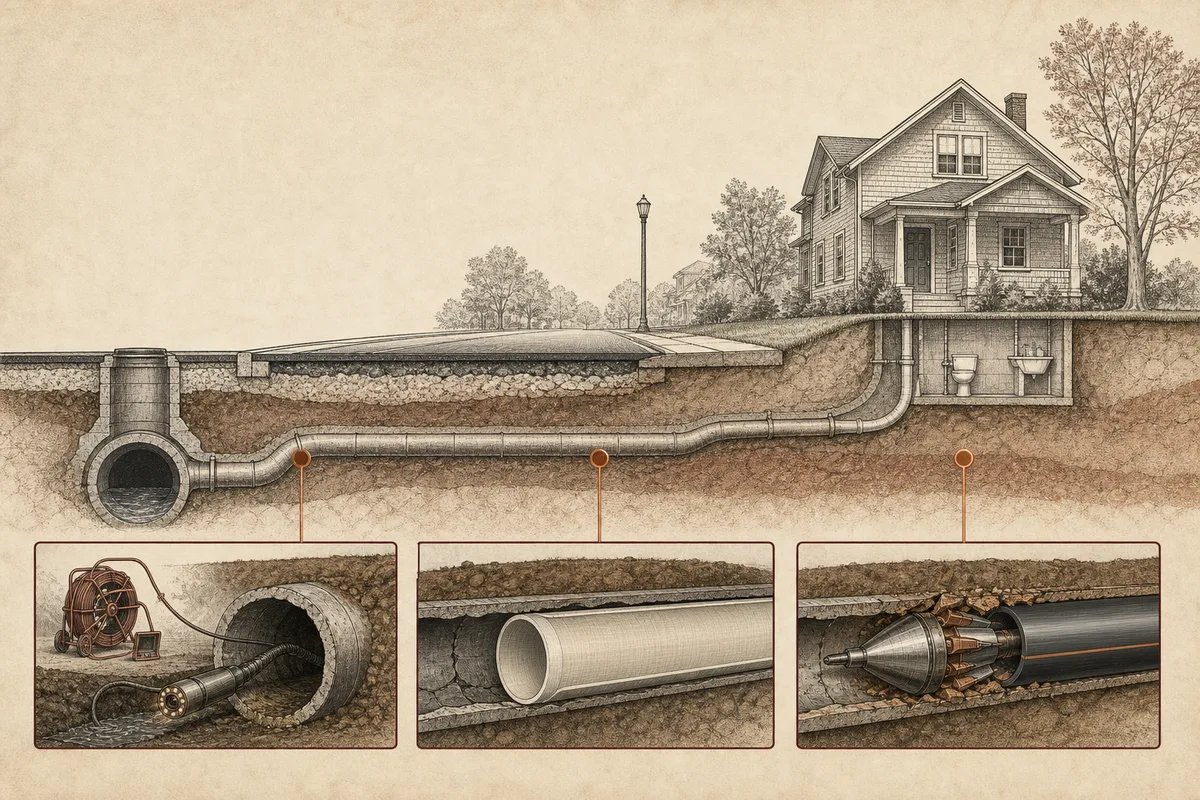
Amherst Elite Trenchless plans trenchless sewer repair for Buffalo, about 12 miles from Amherst within this Western New York service ring. Buffalo is not this site’s primary city, but its older clay and cast-iron lateral stock is common enough across the region that a dedicated field note helps a Buffalo property owner start the same way an Amherst homeowner would: with the camera record, not the housing era alone. Send the property details through the request form before comparing any repair method, or call 716-274-7351 to discuss a Buffalo property directly.
Confirm the serving system before comparing methods
The first decision for a Buffalo address is not lining versus bursting. It is whether the property connects to a sanitary sewer, a combined sewer that also carries stormwater, a limited district line, or a private onsite arrangement. Buffalo’s sewer infrastructure is managed in part through the Buffalo Sewer Authority, which is the jurisdictional starting point for the municipal side of that question, while the Erie County sewer forms library provides county-level sewer contacts and applications that can apply depending on the parcel. A building’s age can suggest which sewer type was in place when it was constructed, but only current property and agency records can confirm what actually serves the address today.
Why Buffalo’s older housing stock changes the camera read
Much of Buffalo’s housing predates the mid-twentieth century, and that era of construction commonly used clay or cast-iron laterals rather than the PVC seen in newer subdivisions. Clay develops joint separations and root entry points as the ground settles and mature street trees reach toward moisture. Cast iron can hold its shape on camera while losing wall thickness from the inside, so a quick look at an unobstructed pass can understate how much material actually remains once cleaning exposes the real bore. City lots in many Buffalo neighborhoods are also narrower and more tightly built than suburban parcels, with shared driveways, close foundations, and alleys that double as utility corridors. None of that is a diagnosis by itself. It is a reason the camera inspection standard used across this site, continuous footage, measured stations, and a clear stopping point, matters just as much on a Buffalo city lot as it does on a larger Amherst parcel.
Local planning markers worth noting for a Buffalo lateral
A pre-war Buffalo block can carry several generations of plumbing work on the same lateral, so a full camera pass is often the only way to see where an old repair meets original pipe. Mature street trees along narrow city rights of way put root pressure directly over many laterals rather than beside them. Shared driveways and tight side yards reduce the space available for a bursting pit or a staged repair, which makes early access planning part of the method comparison rather than an afterthought. A rowhouse or two-family conversion can also have interior plumbing changes that were never reflected in the original lateral layout, so the building drain should be checked separately from the exterior private line.
What a Buffalo camera survey should record
The survey should identify the access point, material, diameter, joints, transitions, visible defects, distance counter, surface locations, and the point where the camera stops. If roots, grease, scale, or standing water hide the pipe wall, that limitation should be recorded as its own finding, with a later clean-pipe pass kept separate so the before-cleaning symptom is not confused with the structural condition underneath it. A note that says roots were present is far less useful than a record that ties root entry to one joint, one material transition, or a repeated interval along the run. On an older cast-iron lateral, the record should also note where scale is thick enough that the true remaining wall thickness cannot yet be judged from video alone.
Trenchless options once the Buffalo defect is mapped
CIPP lining can rehabilitate a cleanable clay, cast-iron, or PVC host with usable geometry, which fits many of the joint-leak and root-entry patterns common in older Buffalo blocks. Epoxy pipe lining is one resin option within that lining process and is often chosen on occupied homes where odor control during cure matters. Pipe bursting can replace a collapsed or badly deforming run where launch and receiving pits are workable, though a narrow city lot or a shared driveway can limit where those pits can go. A full sewer line repair or replacement remains the fallback once the camera record rules the trenchless paths out, whether because of a missing section of pipe wall, an unreachable fitting, or a route that cannot be confirmed with confidence. None of those labels is a remote diagnosis made from a street address; the camera record decides which path stays open for a specific Buffalo parcel.
Local access questions for a Buffalo scope
Narrow lots, shared driveways, alley utility corridors, mature street trees, and finished basement additions all affect where equipment can stage and where a pit, if one is needed, can actually go. Ask who obtains the permit for work on a Buffalo property, who schedules inspection, how excavated material is handled on a tight urban lot, and which surfaces, driveway, sidewalk, or tree lawn, are restored once the work is closed out. A trenchless proposal for a Buffalo address can still include a small pit, interior access, or limited conventional excavation alongside the lining or bursting work.
Cost variables that matter in Buffalo
Cost comes from measured length, depth, access, preparation, diameter, method, groundwater, utility conflicts, permits, inspection, and restoration rather than the city name by itself. An older cast-iron lateral that needs heavier mechanical cleaning before it can be evaluated, or a narrow lot that limits equipment staging, can add a line item that a generic regional estimate would miss. Use the Amherst sewer repair cost guide as a comparison checklist and ask each bidder to price against the same defect map, not a rough citywide average.
Records worth keeping after the work
Retain the property address, system confirmation, complete pre-work video, written defect map, approved scope, permit or inspection records, material information, restoration terms, and closing footage. If the camera could not reach the public connection, keep that limitation with the record so a future owner, buyer, or property manager can tell a documented repair from a general claim that the sewer was fixed.
Nearby field notes in this service ring
Properties closer to the Amherst town line, or along the corridor between Buffalo and Amherst, may match a neighboring field note more closely than this general Buffalo page. Compare the Kenmore, Tonawanda, Cheektowaga, and East Amherst field notes for communities with their own housing-era and access patterns, and confirm the closer match before comparing repair methods for a specific address. A property south of the city, toward West Seneca, Orchard Park, or East Aurora, may match one of those field notes instead.
Immediately south on the Lake Erie shore, the Lackawanna field note covers compact former steel-plant worker neighborhoods and their older clay and cast-iron laterals.
Send a Buffalo property field note
Use the request form to share the street, property type, public sewer or septic status if known, symptoms, and any existing footage, or call 716-274-7351 directly. Review the full Amherst-area coverage ledger before comparing methods.
Repair paths
When a Buffalo sewer line needs more than cleaning
A mapped defect can point past routine cleaning toward a specific repair. A sudden failure that cannot wait is handled as emergency sewer repair in Buffalo, while wastewater returning through a floor drain points toward sewer backup repair for Buffalo homes. Mature trees reaching an aging clay joint are the usual reason for tree root removal on a Buffalo lateral, and a line running beneath a basement floor can call for sewer repair under a slab in Buffalo.
Where the camera record rules out keeping the host pipe, a Buffalo property may compare trenchless sewer replacement in Buffalo or, for a failing supply line, trenchless water line replacement in Buffalo. Older mid-century fiber conduit shows up as Orangeburg pipe replacement across Western New York, and a flooded yard or parking drain can need storm drain pipe repair in Buffalo.
Nearby areas
Sewer and pipe repair near Buffalo
Private sewer and water line context carries across town lines, so the field notes for neighboring communities use the same address-first checks.
Decision check
Confirm the property system before scoping the line
01Is the property on public sewer, a limited district, or septic?
02Which part of the private piping is involved?
03What access, groundwater, surface, or ledge constraints apply?
04Which municipal records or permits should be checked?
Questions
Frequently asked
01Is Buffalo the primary service city for this site?
No. Amherst Elite Trenchless is based in the Amherst trenchless service ring and plans Buffalo properties as part of that same Western New York coverage area. Confirm the property address and serving system before comparing any repair method.
02Is every Buffalo property on the same sewer system?
No. Buffalo has a mix of sanitary and combined sewer infrastructure depending on the neighborhood and era of construction. Confirm the serving system, sewer district, or private connection from current property and agency records rather than the city name alone.
03What should a Buffalo camera report include?
Keep the access point, distance reached, pipe materials, transitions, defect stations, stopping point, and the full unedited video file, the same standard used on every property this site plans for.
04Does trenchless mean a Buffalo city lot avoids digging entirely?
Not always. Lining can often use an existing cleanout, while bursting normally needs launch and receiving pits. A tight urban lot, a shared driveway, or a utility conflict can still require a controlled excavation.
05Can an older Buffalo cast-iron or clay lateral be lined instead of replaced?
Often, once mechanical cleaning confirms the host pipe still holds usable, roughly round geometry. A full collapse, a missing section of pipe wall, or severe scale loss can rule lining out in favor of bursting or a conventional repair.
06Who is responsible for the sewer lateral on a Buffalo property?
The split between the privately owned lateral and the public sewer is set by the serving authority, not by a contractor. The Buffalo Sewer Authority is the jurisdictional starting point for where private responsibility ends and the public connection begins, and that boundary matters because a trenchless repair is planned on the private portion. Confirm the ownership line and any permit requirement for the specific address before comparing methods.