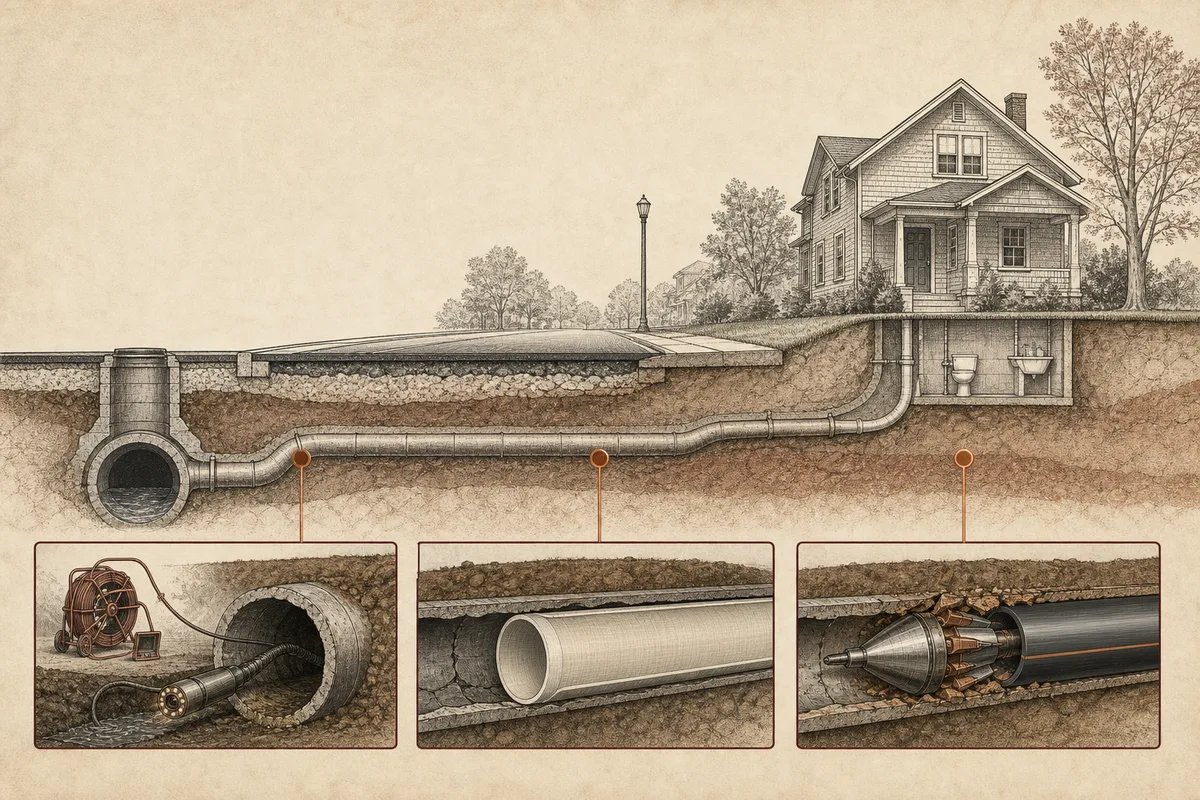
Amherst Trenchless plans trenchless sewer lateral work for Lackawanna, about 16 miles from Amherst in this Western New York service ring. The small Erie County city sits directly south of Buffalo on the Lake Erie shore, between Buffalo, West Seneca, and Hamburg. Its former steel-plant setting and dense older worker housing make private lateral condition and equipment access useful starting questions. Neither the industrial history nor the age of a house establishes what is wrong underground. A measured camera record should lead the repair decision.
Older worker housing calls for a complete lateral record
Closely built residential blocks can leave little space between foundations, driveways, and the route to the street. An older Lackawanna house may retain clay or cast-iron pipe even when its fixtures and interior drains have been updated. A later addition or previous repair can also introduce plastic sections without replacing the entire private lateral. Ask where each material starts and ends rather than treating the line as one continuous generation of pipe.
Clay joints can admit roots where seals have opened or sections have shifted. Cast iron can accumulate scale that narrows the bore and hides the surface beneath it. Those are inspection questions for this housing context, not findings for every Lackawanna address. A recently cleared blockage does not prove that the rest of the route is sound, and a slow drain inside the building does not establish that the exterior lateral needs replacement. Keep the building-drain findings separate from the outside survey so the scope follows the documented problem.
Confirm the connection and city permit path first
Establish where the private line goes, which connection serves the property, and where maintenance responsibility changes before comparing lining with bursting. Current property and connection records matter more than a mailing address or a neighboring owner’s experience. The Erie County sewer forms library, also used in neighboring field notes, is a county-level reference for sewer contacts and applications. It does not replace confirmation of the city permit path for a Lackawanna property.
Before work begins, ask who obtains the required city approvals, who arranges inspection, and whether the planned access affects a sidewalk, street edge, or other public right of way. A proposal should distinguish private-yard restoration from work that requires additional permission. Do not assume a small excavation avoids those questions. A cleanout installation or receiving pit can still reach an area where access and restoration need to be agreed in advance.
What the Lackawanna camera survey should show
A sewer camera inspection should record the starting access, direction of travel, pipe diameter, materials, joints, fittings, transitions, defect distances, and stopping point. Locate important stations at the surface so a defect under a driveway can be distinguished from one beside a foundation or near the public connection. Retain the full recording along with the written observations, including any portion of the route the camera could not reach.
On an older worker-house lateral, ask whether the camera crossed an old repair, an offset joint, or a change from cast iron to clay before reaching the obstruction. A single still image rarely explains those relationships. If roots or deposits block the view, record that limitation and plan appropriate preparation. Hydro jetting or mechanical cleaning may be part of that preparation, depending on pipe condition. Keep the later clean-pipe survey separate so the original symptom and the exposed structural condition remain clear.
Planning markers on a compact Lackawanna lot
Measure the usable space beside the house rather than assuming equipment fits because a person can walk through. Identify steps, fences, basement access, driveway edges, and overhead restrictions along the proposed equipment route. Check whether a drive or access strip is shared and whether permission is needed to use it. Mark utilities before choosing pit locations. These details can determine whether a method that looks suitable on camera can actually be installed from the available surface positions.
Lake Erie shoreline geography is part of Lackawanna’s setting, but it does not establish groundwater depth or explain every backup. Log rainfall timing and observed water entry separately from pipe defects. If standing water obscures the bore, document its extent and investigate grade before promising a liner will resolve the symptom. A neighborhood description should guide questions, while the parcel survey supplies the answers.
Lining, bursting, and selective repair in Lackawanna
Trenchless pipe lining can rehabilitate a cleanable host with usable geometry. For a Lackawanna clay lateral with documented joint defects, that means checking continuity and access through the full proposed lining length. For cast iron, preparation must expose enough of the bore to judge whether a suitable host remains. Epoxy pipe lining is an option within lining work; ask how preparation, cure, connection openings, and closing inspection will be documented for the selected system.
Pipe bursting replaces a run by drawing new pipe along the existing route, with launch and receiving access and appropriate utility clearance. Dense housing makes those pit locations a practical part of the comparison. A collapsed section does not automatically make bursting feasible if nearby utilities or restricted staging prevent the work. Have the contractor explain the proposed route, required excavations, and any access limitations before accepting that method.
A spot repair can address a bounded defect where surrounding pipe is suitable to remain. Broader sewer line repair or replacement may be needed for a grade problem, an inaccessible fitting, or a route that cannot support the proposed trenchless installation. The scope can combine limited excavation with lining elsewhere. Describe each segment and its purpose so the owner can compare the same work across proposals.
Compare preparation and restoration as well as method
Lackawanna’s compact residential lots make staging and surface work relevant even when most of the lateral stays buried. Ask where removed material will go, how access to the home will be maintained, and how long plumbing use will be restricted. A driveway crossing, sidewalk opening, or pit near a foundation should have a defined restoration scope, including who handles inspection before the opening is closed.
Measured length, depth, diameter, cleaning, utility clearance, groundwater, permits, and restoration drive the scope. The city name is not a substitute for those measurements. Use the Amherst sewer repair cost guide to compare included work, exclusions, and unresolved conditions. A proposal based on an incomplete camera pass should identify what still needs investigation and how that finding could change the method.
Keep a closing record for the next owner
Retain the initial and cleaned-pipe footage, surface locations, material transitions, approved scope, permit and inspection records, installed material information, and final video. For a partial repair, identify where new work meets retained clay or cast iron. If inspection stopped short of the connection, preserve that limitation. These records are especially useful when an older Lackawanna home has accumulated several separate plumbing repairs that are no longer visible from the finished yard.
Nearby field notes in this service ring
Compare Buffalo immediately north for another older city-lateral context, West Seneca to the east for its postwar housing and wet-weather questions, and Hamburg to the south for its wider town and shoreline setting. Lackawanna’s compact former steel-plant worker neighborhoods deserve their own access and material checks even where the municipal boundaries are close. Confirm the field note that fits the actual property before comparing repair methods.
Send a Lackawanna property field note
Use the request form to share the property location, building type, symptoms, known connection details, and existing camera footage. Include any concern about a shared drive, tight side yard, or work near the sidewalk. Review the full Amherst-area coverage ledger for the surrounding planning ring.
Repair paths
When a Lackawanna sewer line needs more than cleaning
A mapped defect can point past routine cleaning toward a specific repair. A sudden failure that cannot wait is handled as emergency sewer repair in Lackawanna, while wastewater returning through a floor drain points toward sewer backup repair for Lackawanna homes. Mature trees reaching an aging clay joint are the usual reason for tree root removal on a Lackawanna lateral, and a line running beneath a basement floor can call for sewer repair under a slab in Lackawanna.
Where the camera record rules out keeping the host pipe, a Lackawanna property may compare trenchless sewer replacement in Lackawanna or, for a failing supply line, trenchless water line replacement in Lackawanna. Older mid-century fiber conduit shows up as Orangeburg pipe replacement across Western New York, and a flooded yard or parking drain can need storm drain pipe repair in Lackawanna.
Nearby areas
Sewer and pipe repair near Lackawanna
Private sewer and water line context carries across town lines, so the field notes for neighboring communities use the same address-first checks.
Decision check
Confirm the property system before scoping the line
01Is the property on public sewer, a limited district, or septic?
02Which part of the private piping is involved?
03What access, groundwater, surface, or ledge constraints apply?
04Which municipal records or permits should be checked?
Questions
Frequently asked
01Does Lackawanna's steel-plant history tell me what pipe serves my house?
It gives context for the older worker housing, but it does not identify a particular lateral. Camera footage and property records should establish the material, route, and any replacement sections before a repair is selected.
02Can a liner correct a low section beneath a Lackawanna driveway?
A liner follows the existing pipe route and generally does not correct its grade. Locate and measure the low section, then compare a targeted excavation or replacement with any lining proposed for the remaining sound route.
03What if my side yard has no room for bursting equipment?
Have the contractor mark proposed launch and receiving pits, equipment access, and utility clearance before recommending bursting. Restricted access can change the method or require a different excavation plan.
04Who should confirm permission for work near a Lackawanna sidewalk?
Confirm the city permit path before work, including any right-of-way permission and inspection requirements. The written scope should name who obtains approvals and who restores the sidewalk or other affected surfaces.
05Should cast iron be judged before or after scale removal?
Keep the initial footage, then obtain a separate inspection after appropriate cleaning exposes the bore. Scale can hide deterioration, so an open drain alone is not evidence that the remaining host pipe is suitable for lining.