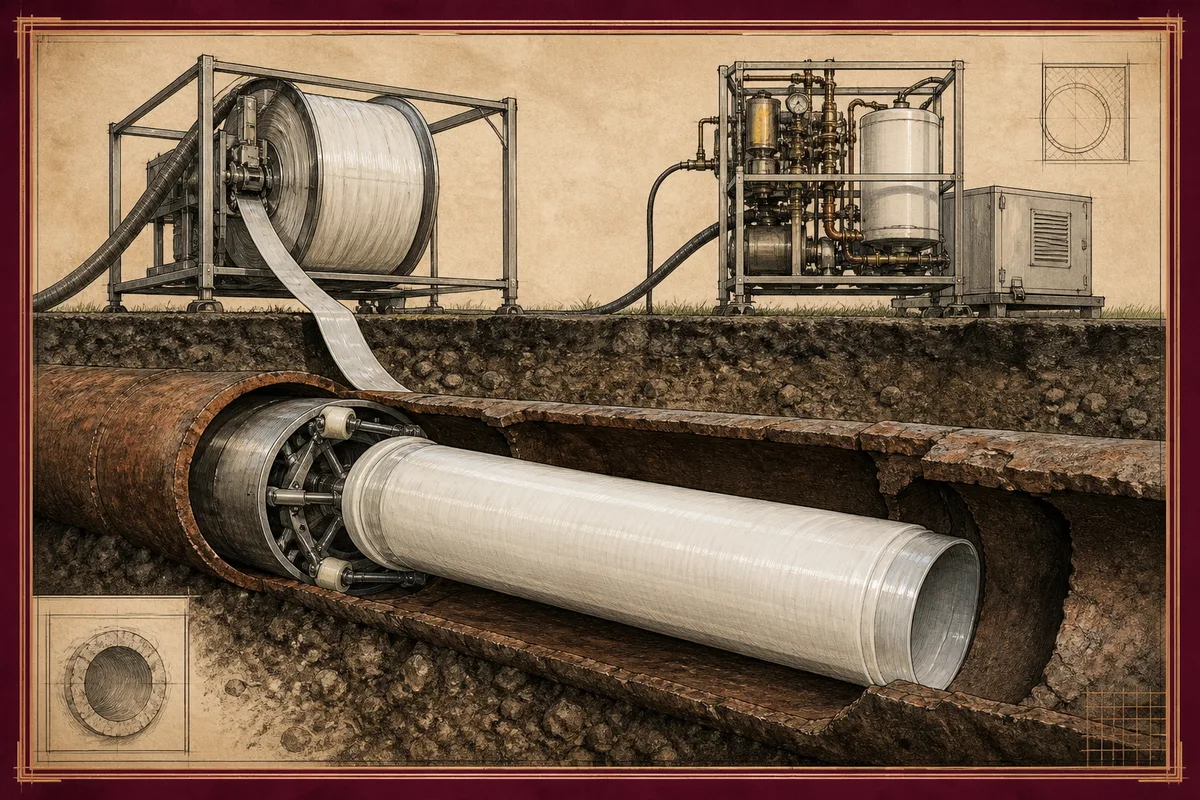
Amherst Elite Trenchless explains epoxy pipe lining for Amherst and Western New York homeowners whose clay or cast-iron lateral has a camera-confirmed defect. Epoxy pipe lining uses an epoxy resin to saturate the felt or fiberglass tube that forms a cured-in-place liner, so the resin choice, not the lining method itself, is what this page covers in detail. For the broader cured-in-place process, see trenchless pipe lining (CIPP), which this page assumes as background.
What epoxy pipe lining actually is, and what it is not
A professional epoxy liner is manufactured to measured dimensions, saturated with resin under controlled conditions, pulled or inverted into the cleaned host pipe through an existing cleanout or a small access point, and cured until it forms a smooth, jointless pipe inside the old one. That is a different product and a different risk profile than a retail pour-in epoxy kit marketed for homeowners to pour down a drain or toilet. A poured liquid cannot be measured for thickness, cannot be inspected for voids while it cures against the pipe wall, and has no camera-confirmed starting condition to compare against afterward. If a search brought a homeowner here looking for a do-it-yourself pour-down product, the short answer is that a buried lateral is not a good candidate for an unsupervised liquid repair, and a camera-confirmed professional installation is the only way to know the liner actually formed where it needed to.
This page also is not a laboratory testing or materials-certification resource. It explains epoxy lining as a homeowner repair option, not resin chemistry testing protocols. For material science or test-method questions, an engineering or manufacturer resource is the better source.
Epoxy resin vs polyester resin in a cured-in-place liner
Both epoxy and polyester resins can saturate the same felt or fiberglass tube and cure into a structural liner. The practical differences homeowners notice most often are odor during cure and bonding behavior on certain host materials. Epoxy tends to produce less of the sharp styrene smell associated with polyester cure, which matters in an occupied home with nearby fixtures still in use. Epoxy also bonds well to cast iron and clay, two of the materials most common in older Amherst neighborhoods. Polyester can be a reasonable choice on other jobs where cure speed or material cost matters more than odor control. Neither resin changes the underlying rule that the host pipe must be cleaned and camera-confirmed to hold a usable, roughly round shape before any liner is proposed.
How an Amherst epoxy pipe lining installation works
- Camera the line to confirm material, diameter, and the specific defects that make it a liner candidate.
- Clean the host pipe mechanically so the liner seats against sound wall rather than scale, roots, or grease.
- Measure the confirmed run and cut the felt or fiberglass tube to length.
- Saturate the tube with epoxy resin under controlled conditions immediately before installation.
- Insert or invert the saturated tube through the existing cleanout or a small access point and press it against the host pipe wall.
- Cure the resin with hot water, steam, or another controlled method until the liner hardens into the new interior surface.
- Cut open and reinstate each active branch or lateral connection from inside the new liner.
- Run a closing camera pass to confirm the liner formed correctly and every reinstated connection is clear.
What happens if cleaning finds a bigger problem than expected
Mechanical cleaning on an older cast-iron or clay lateral sometimes exposes a collapsed section, a flattened run, or a joint that has lost most of its original wall. The written scope should say in advance what happens next: a revised proposal before work continues, not a field decision made without the property owner. Ask how that decision point gets documented before any cleaning begins.
Signs an Amherst lateral is a good epoxy lining candidate
A recurring backup, a slow fixture, a sewer odor, or a failed camera inspection can point toward the same pipe, but none of those symptoms identify the repair method by themselves. Camera evidence is what turns a symptom into a defect map. An epoxy liner fits best once cleaning shows usable geometry and the recorded defects are joint leaks, root openings, hairline cracks, or interior corrosion on clay, cast iron, Orangeburg, or PVC, rather than a structural collapse of the pipe wall itself. Cast-iron laterals in particular should be evaluated against the standards on the cast iron pipe lining page, since scale buildup there can hide how much sound wall actually remains.
When epoxy pipe lining is not the right fit
A liner follows the existing grade. It cannot lift a belly, reopen a full collapse, or correct severe ovality. Other conditions that can rule out lining include an unknown shared connection, a sharp change of direction, an inaccessible fitting, unstable soil, groundwater intrusion, an adjacent utility, or a route that cannot be located with confidence. In those cases, pipe bursting, a targeted spot repair, or a conventional sewer line repair or replacement may match the recorded condition better than a liner would. A line with heavy ongoing grease or root buildup should also go through hydro jetting or mechanical cleaning first, since a liner cannot be proposed against a wall the camera cannot actually see.
Amherst access, permits, and property responsibility
The Town of Amherst actively addresses infiltration and inflow in its sanitary sewer system, and its program describes public inspection and rehabilitation work, including camera televising and cured-in-place lining, while private-property responsibility remains a separate question. The Town of Amherst sanitary sewer I&I program is an authoritative starting point for municipal context, and the Erie County Division of Sewerage Management forms publishes county-level sewer forms and contacts. Confirm the current permit holder, inspection notice, utility marking, and the point where private responsibility meets the public connection before scheduling any lining work, since the actual requirement still needs address-level confirmation.
What drives the scope and effort of an epoxy lining job
The amount of work behind an epoxy lining job changes with the length and depth of the run, the pipe diameter, access conditions, how much cleaning the host pipe needs, the liner material, equipment placement, groundwater, and surface restoration once the job is closed out. A short, shallow, easily accessed run with a clean camera record is a simpler job than a long, deep run buried under a driveway with heavy root intrusion. Use the Amherst sewer repair cost guide as a comparison checklist rather than a remote estimate, and ask each bidder to identify assumptions, allowances, and exclusions against the same defect map so that cleaning, access, liner material, branch reinstatement, and restoration can all be compared line by line.
What to keep on file after an epoxy lining job
Keep the pre-work camera record, the approved written scope, the resin and liner product data, any permit or inspection signoff, and the closing camera pass that shows the finished liner and every reinstated connection. The closing record should identify the same segment and stations described before the work began. For a purchase, a managed property, or a future tenant handoff, store those files with the property records so a later maintenance or warranty question has something concrete to reference. Properties near East Amherst with newer PVC joints under seasonal ground movement, and older Amherst blocks with clay or cast iron, both benefit from keeping that same closing record on file.
Request an epoxy pipe lining review for your Amherst property
Send the property address, pipe material if known, symptoms, any existing camera footage, and access concerns through the review form, or call 716-274-7351 to discuss the property directly. This site provides planning information and routes requests; a qualified local provider must inspect the property before issuing a final scope.
Service area
Areas we serve across Western New York
Areas we serve in Erie County
Epoxy Pipe Lining in Amherst, Epoxy Pipe Lining in Boston, Epoxy Pipe Lining in Buffalo, Epoxy Pipe Lining in Cheektowaga, Epoxy Pipe Lining in City of Tonawanda, Epoxy Pipe Lining in Clarence, Epoxy Pipe Lining in Clarence Center, Epoxy Pipe Lining in Depew, Epoxy Pipe Lining in East Amherst, Epoxy Pipe Lining in East Aurora, Epoxy Pipe Lining in Eggertsville, Epoxy Pipe Lining in Elma, Epoxy Pipe Lining in Getzville, Epoxy Pipe Lining in Grand Island, Epoxy Pipe Lining in Hamburg, Epoxy Pipe Lining in Holland, Epoxy Pipe Lining in Kenmore, Epoxy Pipe Lining in Lackawanna, Epoxy Pipe Lining in Lancaster, Epoxy Pipe Lining in Orchard Park, Epoxy Pipe Lining in Snyder, Epoxy Pipe Lining in Tonawanda, Epoxy Pipe Lining in West Seneca, Epoxy Pipe Lining in Williamsville
Areas we serve in Niagara County
Epoxy Pipe Lining in Lockport, Epoxy Pipe Lining in North Tonawanda
Decision check
Questions a useful recommendation should answer
01What material, diameter, and defects appear on the camera footage?
02What preparation is required before the proposed method can work?
03Which alternatives were ruled out, and why?
04What closing evidence and written scope will the property owner keep?
Questions
Frequently asked
01Is epoxy pipe lining the same thing as a retail pour-in epoxy kit?
No. A professional epoxy liner is a resin-saturated felt or fiberglass tube that is measured, inserted through an access point, pressed against the cleaned host pipe, and cured into a continuous structural wall. A pour-in kit sold for homeowner use coats whatever surface the liquid happens to reach and cannot confirm thickness, cure, or coverage on a buried line.
02Why would an Amherst homeowner choose epoxy resin over polyester resin?
Epoxy generally produces less odor during cure and bonds well to cast iron and clay, which makes it a common choice for occupied homes where a strong styrene smell during installation is a concern. Polyester can cure faster and cost less in some applications. The camera-confirmed condition of the host pipe, not a general resin preference, should decide the method.
03Can epoxy pipe lining go inside an old cast-iron lateral?
Often, once mechanical cleaning removes scale and exposes sound wall with enough remaining thickness to support a liner. See the dedicated cast-iron pipe lining page for how that cleaning and evaluation step works before a liner is proposed.
04Will epoxy pipe lining avoid digging up an Amherst yard?
Frequently, when an existing cleanout or a small access point reaches the defect and the host pipe still holds a usable round shape. A collapsed section, a severe belly, or an unreachable fitting can still require a controlled excavation instead.
05What should be kept after an epoxy lining job is finished?
Retain the pre-work camera file, the written scope, the resin and liner product data, any permit or inspection record, and a closing camera pass that confirms the liner formed correctly and every reinstated connection is clear.