Amherst Elite Trenchless is based in the Town of Amherst and maintains this town-wide field note alongside the neighborhood-specific pages covering the hamlets and villages inside it. Send the property details through the request form before comparing any repair method, or call 716-274-7351 to discuss a specific Amherst address directly.
One town government, two very different housing eras
The Town of Amherst is not a single uniform housing stock, and a camera crew should not treat it that way. Blocks closer to the Buffalo city line and older sections toward Eggertsville and Snyder were largely built before the mid-1960s, when clay and cast-iron laterals were the standard material. Clay in that era develops joint separations and root intrusion as the surrounding soil settles and mature trees reach toward moisture, while cast iron can hold a round shape on camera even as its wall thins from corrosion on the inside. Subdivisions built from the 1970s through the 2000s, concentrated toward East Amherst and Getzville, used PVC instead, which fails less from corrosion and more from joint stress where seasonal ground movement works a connection loose over time. A property’s construction decade is a reasonable starting assumption, not a substitute for what the pipe itself shows once a camera is run.
The Time of Sale rule applies to a specific slice of the town
A Town of Amherst sanitary sewer inflow and infiltration review, known locally as the Time of Sale inspection, applies to covered residential structures built before 1965 inside a designated district, ahead of a property transfer. That is a municipal requirement layered on top of, not a replacement for, a private camera scope requested for due diligence or a known symptom. A buyer, seller, agent, or attorney working on an older Amherst property should confirm directly with the town whether the parcel falls inside the covered district and which forms currently apply, since boundaries and procedures are set by the town rather than by any contractor’s estimate. The Amherst Time of Sale field guide walks through how that municipal review fits into a typical purchase timeline, and the Town of Amherst Time of Sale program page is the direct source for current district maps and paperwork.
Confirm the serving system before comparing methods
Before lining is compared with bursting, the more basic question is whether a given Amherst address uses a public lateral, a limited sewer district connection, a private onsite system, or some other arrangement. That answer depends on the parcel, not on the town’s reputation as mostly served by public sewer. The Erie County sewer forms library holds county-level contacts and applications that can apply depending on where the district lines fall. A neighborhood’s general reputation for public sewer service is a reasonable planning assumption, but only current property and agency records confirm what actually serves one address.
What a camera survey should record anywhere in town
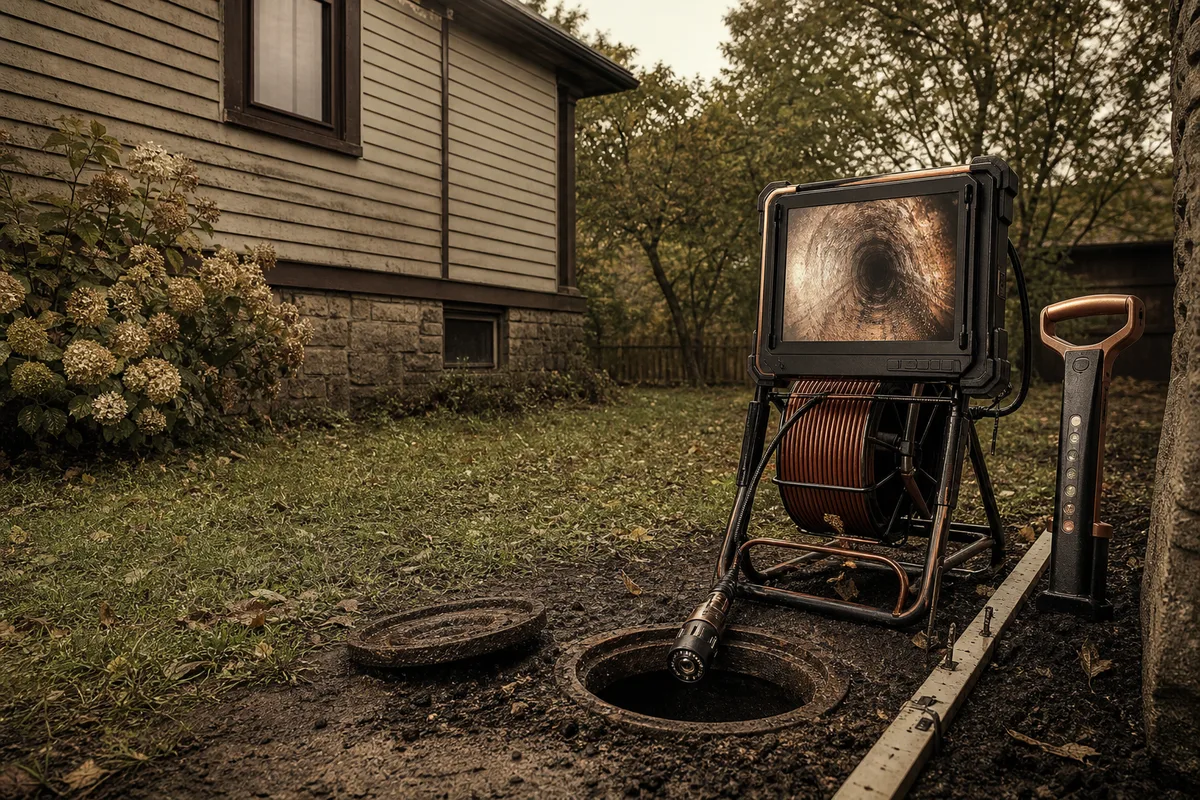
The standard does not change by neighborhood. A survey should identify the access point, material, diameter, joints, transitions, visible defects, a distance counter, surface locations, and the point where the camera stops. If roots, grease, scale, or standing water hide the pipe wall during that pass, that limitation belongs in the record as its own finding, with a later clean-pipe pass kept separate so a before-cleaning symptom is not mistaken for the structural condition underneath it. Camera inspection is the step that turns a backup, a slow fixture, or a flagged Time of Sale item into a specific defect map rather than a guess based on the block’s age. A pre-purchase sewer inspection follows the same recording standard, timed to fit a purchase contingency window rather than an active symptom.
Trenchless options once the defect is mapped
CIPP lining can rehabilitate a cleanable clay, cast-iron, or PVC host that still holds usable, roughly round geometry, which covers a large share of the joint-leak and root-entry patterns found across both the town’s older blocks and its newer subdivisions. Pipe bursting can replace a collapsed or badly deforming run where launch and receiving pits are workable, though a tight older lot near the city line can limit pit placement more than a wider suburban parcel further out. A full sewer line repair or replacement remains the fallback once the camera record rules out both trenchless paths, whether because of a missing section of pipe wall, an unreachable fitting, or a route that cannot be confirmed with confidence. None of those three labels is a remote diagnosis made from a street address; the recorded defect map decides which path stays open for a given property.
Matching the right neighborhood field note
This page sets the town-wide context, but an individual property usually matches a more specific neighborhood pattern better than a town-wide average. The East Amherst field note covers the newer PVC subdivisions built from the 1980s through the 2000s, where joint stress and sump cross-connections are the more common findings. The Williamsville field note covers the prewar village core near shallow bedrock, where excavation access is often the tighter constraint. The Snyder and Eggertsville field notes cover other older sections of town with their own mix of housing era and soil conditions. Check whether one of those pages matches the actual address before comparing repair methods, since the defect patterns described there are specific to that area rather than the town as a whole.
Cost variables that matter across the town
Cost comes from measured length, depth, access, preparation, diameter, method, groundwater, utility conflicts, permits, inspection, and restoration rather than from which part of Amherst a property sits in. An older lateral that needs heavier mechanical cleaning before it can be evaluated, or a Time of Sale finding that adds a correction step ahead of closing, can add a line item that a generic town-wide estimate would miss. The Amherst sewer repair cost drivers field note breaks down which camera findings actually move a bid, and the Amherst sewer repair cost guide works as a comparison checklist so each bidder can be asked to price against the same defect map.
Records worth keeping after the work
Retain the property address, system confirmation, complete pre-work video, written defect map, approved scope, permit or inspection records, material information, restoration terms, and closing footage. If the camera could not reach the public connection or an onsite destination, keep that limitation with the record so a future owner, buyer, or property manager can tell a documented repair from a general claim that the sewer was fixed. For a pre-1965 Amherst property, keep any Time of Sale correspondence with that same file, since a later transfer can raise the same question again.
Send a Town of Amherst field note
Use the request form to share the street, property type, public sewer or septic status if known, symptoms, and any existing footage, or call 716-274-7351 directly. Review the full Amherst-area coverage ledger for the neighborhood field notes that sit inside and around this town before comparing repair methods.
Repair paths
When a Amherst sewer line needs more than cleaning
A mapped defect can point past routine cleaning toward a specific repair. A sudden failure that cannot wait is handled as emergency sewer repair in Amherst, while wastewater returning through a floor drain points toward sewer backup repair for Amherst homes. Mature trees reaching an aging clay joint are the usual reason for tree root removal on a Amherst lateral, and a line running beneath a basement floor can call for sewer repair under a slab in Amherst.
Where the camera record rules out keeping the host pipe, a Amherst property may compare trenchless sewer replacement in Amherst or, for a failing supply line, trenchless water line replacement in Amherst. Older mid-century fiber conduit shows up as Orangeburg pipe replacement across Western New York, and a flooded yard or parking drain can need storm drain pipe repair in Amherst.
Nearby areas
Sewer and pipe repair near Amherst
Private sewer and water line context carries across town lines, so the field notes for neighboring communities use the same address-first checks.
Decision check
Confirm the property system before scoping the line
01Is the property on public sewer, a limited district, or septic?
02Which part of the private piping is involved?
03What access, groundwater, surface, or ledge constraints apply?
04Which municipal records or permits should be checked?
Questions
Frequently asked
01Does every property in the Town of Amherst follow the same sewer rules?
No. The Time of Sale sanitary sewer inflow and infiltration review applies to covered residential structures built before 1965 in a designated district, not to every parcel in town. Confirm current coverage and forms directly with the Town of Amherst before a transfer.
02What is the Town of Amherst Time of Sale sewer inspection?
It is a municipal inflow and infiltration inspection required for covered pre-1965 homes in the designated district before title transfer. It can overlap with a private camera scope, but the two should not be treated as the same inspection.
03Why do some Amherst blocks get compared to clay or cast iron and others to PVC?
Housing era varies across the town. Older sections built before the mid-1960s commonly used clay or cast-iron laterals, while subdivisions built from the 1970s onward typically used PVC. The camera record, not the decade alone, should confirm what is actually in the ground.
04Does trenchless mean an Amherst property avoids digging entirely?
Not always. Lining can often use an existing access point, while bursting normally needs launch and receiving pits. A collapse, a fitting that cannot be reached, or a route change can still call for selective excavation.
05Should I use this town-wide page or a specific Amherst neighborhood field note?
Check whether a closer neighborhood page matches the property first. East Amherst, Williamsville, Snyder, and Eggertsville each have their own field note built around that area's housing era and ground conditions.