Amherst Elite Trenchless maintains this Elma field note for an Erie County southtown about 22 miles from Amherst in the service planning ring. The distance and approximate population marker describe coverage planning, not a measured trip or a finding about any property. Elma’s larger rural and semi-rural lots put a different set of questions first: where the building drain actually goes, how much pipe lies between the house and its destination, and whether that destination is public sewer or a private onsite system.
Larger Elma lots make the route matter
Elma sits between the East Aurora, Orchard Park, and Hamburg corridor planning contexts. Here, a broad lawn and a long driveway can separate the building from the street by much more than a compact village lot would suggest. That setback can mean a longer lateral, but the driveway length alone cannot establish the pipe length. A pipe may turn around an addition, cross a side yard, or head toward an onsite tank instead of continuing to a street connection. Start with records and a located inspection rather than drawing a straight line from the front door to the road.
The practical advantage of a larger Elma parcel is potential room for equipment and access. The limitation is that open ground can conceal an uncertain route, drainage features, private utilities, and surfaces that still need protection. Ask where a crew can travel and stage materials before assuming that a wide yard makes every repair straightforward.
Confirm public sewer or septic at the parcel
For an Elma property, confirm the serving utility or district, any recorded public connection, and any onsite system from current property and agency records. A nearby property’s connection does not settle what serves this parcel. Older repair paperwork, available connection records, and onsite layout records can help identify the destination and clarify which parts of the system belong in the proposed scope. Keep unresolved details visible rather than converting an assumption into a sewer repair recommendation.
The Erie County sewer forms library, also referenced by neighboring field notes, is a starting resource when county sewer records apply. Confirm the actual permit and inspection path for the address and type of work before scheduling. Ask who obtains approvals and whether work near the street or right of way needs separate coordination. For septic properties, establish the applicable onsite approval path; repairing a building-to-tank pipe does not establish that the tank or disposal area functions correctly.
Western New York clay and long setbacks
Western New York clay is a useful planning consideration for Elma, especially where the proposed pipe route crosses a broad lawn or runs beside a long driveway. Moisture-retaining ground can affect equipment travel, pit conditions, and restoration timing. Record soft areas and places where runoff collects before choosing a staging location. A dry driveway surface does not tell the crew whether the ground alongside it can carry equipment without damage.
Clay conditions are not proof of a broken lateral. Joint movement, root entry, and standing water each need pipe evidence. On a longer Elma run, locating the affected station matters because a defect near the house and one near the road may require very different access. Compare surface drainage observations with the located pipe route without assuming that every wet patch marks a leak.
Build a complete camera record
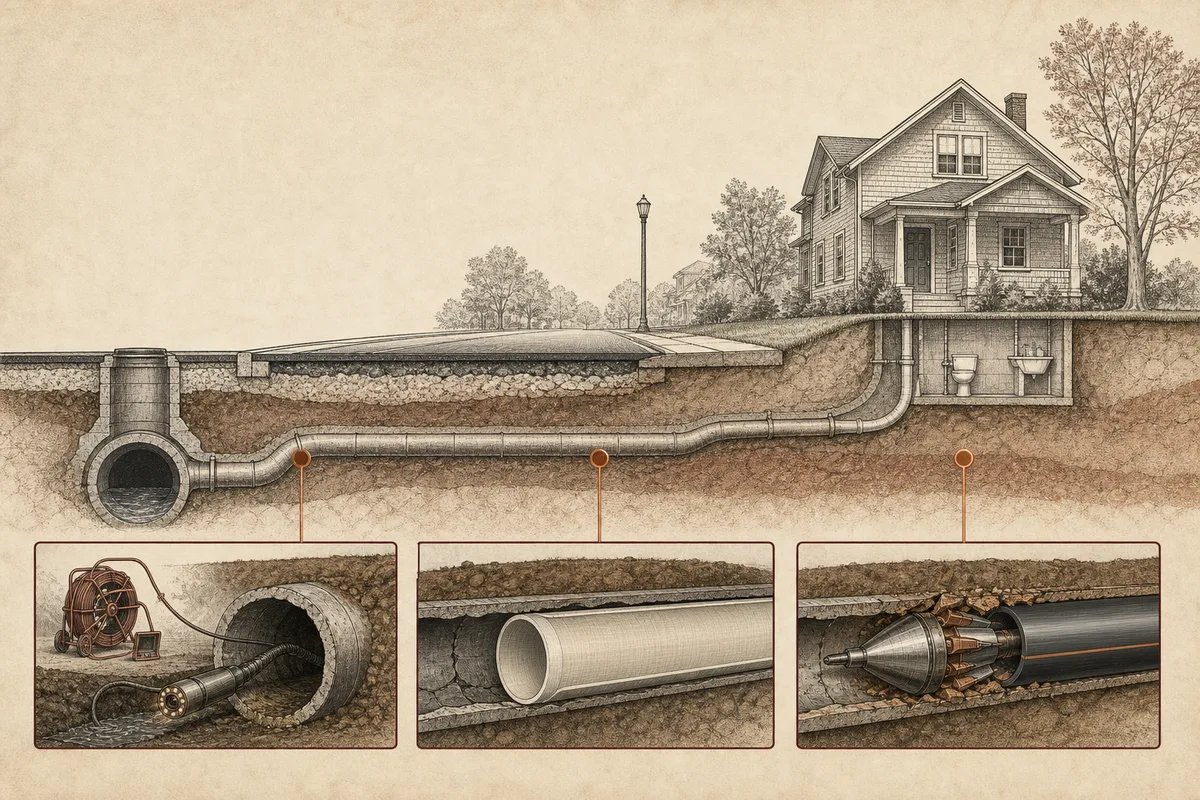
A sewer camera inspection should document the access point, direction of travel, distance reached, pipe materials, diameter, transitions, visible defects, and stopping point. Locate relevant stations at the surface so a proposal can describe where work will happen on the Elma parcel. Keep the complete footage, including any section that could not be assessed. A long run that ends at an obstruction is a partial survey, even when the accessible section looks sound.
If roots or deposits hide the wall, document the initial condition and the cleaning plan. Hydro jetting or another suitable cleaning approach may expose the pipe for a second pass when its condition allows. Cleaning and structural repair are separate decisions. For Elma’s longer driveway-to-street routes, confirm that access and equipment can reach the intended endpoint before promising a complete lining or replacement scope.
Compare lining, bursting, and selective excavation
Trenchless pipe lining can be considered when an Elma host pipe can be cleaned and retains suitable geometry for the proposed system. A liner can address qualifying joint and wall defects while reducing excavation along the route. It follows the existing pipe, however, so it does not lift a sag or create a new slope. Document standing water and any measurement limits before presenting lining as the answer to recurring backups.
Pipe bursting replaces pipe along an existing route where the layout, adjacent utilities, ground conditions, and access support that method. A larger Elma lot may offer potential launch and receiving locations, but pit positions still need a site assessment. Bends, connections, clearance, and the condition of the existing run can constrain the work. Describe the required openings and any separate repairs in the written proposal.
Sewer line repair or replacement may require selective or more extensive excavation when the route, grade, or damage prevents a suitable trenchless scope. Compare methods against the same located defects. A long lateral does not automatically favor one method, and preserving a driveway is only useful if the finished pipe also addresses the documented failure.
Plan access and restoration before work
On an Elma rural or semi-rural parcel, mark the intended equipment route as carefully as the pipe route. Identify drive surfaces, landscaping, trees, drainage swales, outbuildings, private utility runs, and any known onsite system components. Confirm where excavated material can go and where deliveries can be staged. A wide setback can provide working space while still requiring protection of a lawn or driveway edge.
The scope should show each proposed pit or cleanout location and describe backfill, surface repair, and drainage restoration responsibilities. Include service interruption arrangements and the inspection sequence. If public connection work is involved, confirm the boundary between private work and the serving system’s requirements from the records for that Elma address. Do not assume the same permit route applies to another property farther along the road.
Compare measured scopes and keep the evidence
Use the sewer repair cost guide to compare length, depth, cleaning, access, method, utilities, approvals, inspection, and restoration. For Elma, a longer driveway-to-street lateral can change the amount of preparation and access planning, but lot size alone is not a price. Ask each proposal to identify the inspected endpoint, excluded sections, and the conditions that would require a revised scope.
Keep system confirmation, the original footage, located defect notes, approved work description, permit and inspection records, material details, and closing video together. Where the repair covers only part of an Elma lateral, the closing record should make those limits clear. That distinction helps a later owner understand what was renewed and what remains beyond the completed work.
Nearby southtowns field notes
Compare East Aurora for its Main Street and Roycroft village context, Orchard Park for its village core and later subdivisions, Hamburg for its Lake Erie and Eighteen Mile Creek setting, and Holland for its deep farm parcels and long private runs farther southeast. Elma’s field note centers instead on larger rural and semi-rural parcels, longer setbacks, and address-level sewer or septic confirmation. Nearby geography helps frame questions; the parcel records and camera evidence determine the repair.
Use the request form to share the Elma property location, known system type, symptoms, access concerns, and existing footage. The coverage ledger lists the surrounding service ring for comparison.
Repair paths
When a Elma sewer line needs more than cleaning
A mapped defect can point past routine cleaning toward a specific repair. A sudden failure that cannot wait is handled as emergency sewer repair in Elma, while wastewater returning through a floor drain points toward sewer backup repair for Elma homes. Mature trees reaching an aging clay joint are the usual reason for tree root removal on a Elma lateral, and a line running beneath a basement floor can call for sewer repair under a slab in Elma.
Where the camera record rules out keeping the host pipe, a Elma property may compare trenchless sewer replacement in Elma or, for a failing supply line, trenchless water line replacement in Elma. Older mid-century fiber conduit shows up as Orangeburg pipe replacement across Western New York, and a flooded yard or parking drain can need storm drain pipe repair in Elma.
Nearby areas
Sewer and pipe repair near Elma
Private sewer and water line context carries across town lines, so the field notes for neighboring communities use the same address-first checks.
Decision check
Confirm the property system before scoping the line
01Is the property on public sewer, a limited district, or septic?
02Which part of the private piping is involved?
03What access, groundwater, surface, or ledge constraints apply?
04Which municipal records or permits should be checked?
Questions
Frequently asked
01Does a long Elma driveway show where the sewer lateral runs?
No. A driveway is a surface reference, not a pipe map. Locate the lateral from accessible pipe and camera stations, then compare that route with property records before planning access or restoration.
02What if my Elma records identify a septic system?
Confirm the onsite layout and the approval path for the proposed work before comparing sewer repair methods. A building-to-tank pipe problem and a tank or disposal-area problem require different scopes.
03Can lining correct a low spot on a larger Elma lot?
A liner follows the host pipe and does not reset its slope. Standing water needs a documented assessment of grade and cause; excavation may be necessary where the pipe must be repositioned.
04Why might an Elma inspection need more than one access point?
A longer run, bends, or an obstruction can prevent a complete camera pass from one opening. Record what was reached and plan any additional access before treating the survey as complete.
05What should an Elma driveway restoration scope specify?
Identify the access locations, affected surface materials, excavation limits, backfill and finish responsibilities, and any follow-up work. Include lawn and drainage restoration wherever equipment or pits affect them.